ENTERPRISE WIDE COMPUTING
Enterprise-Wide Computing introduces learners to the technologies, architectures, systems, and strategies used to integrate computing resources across an entire organization. The course explores enterprise information systems, enterprise architecture, ERP, CRM, databases, networking, cloud computing, system integration, security, business process automation, and emerging enterprise technologies.
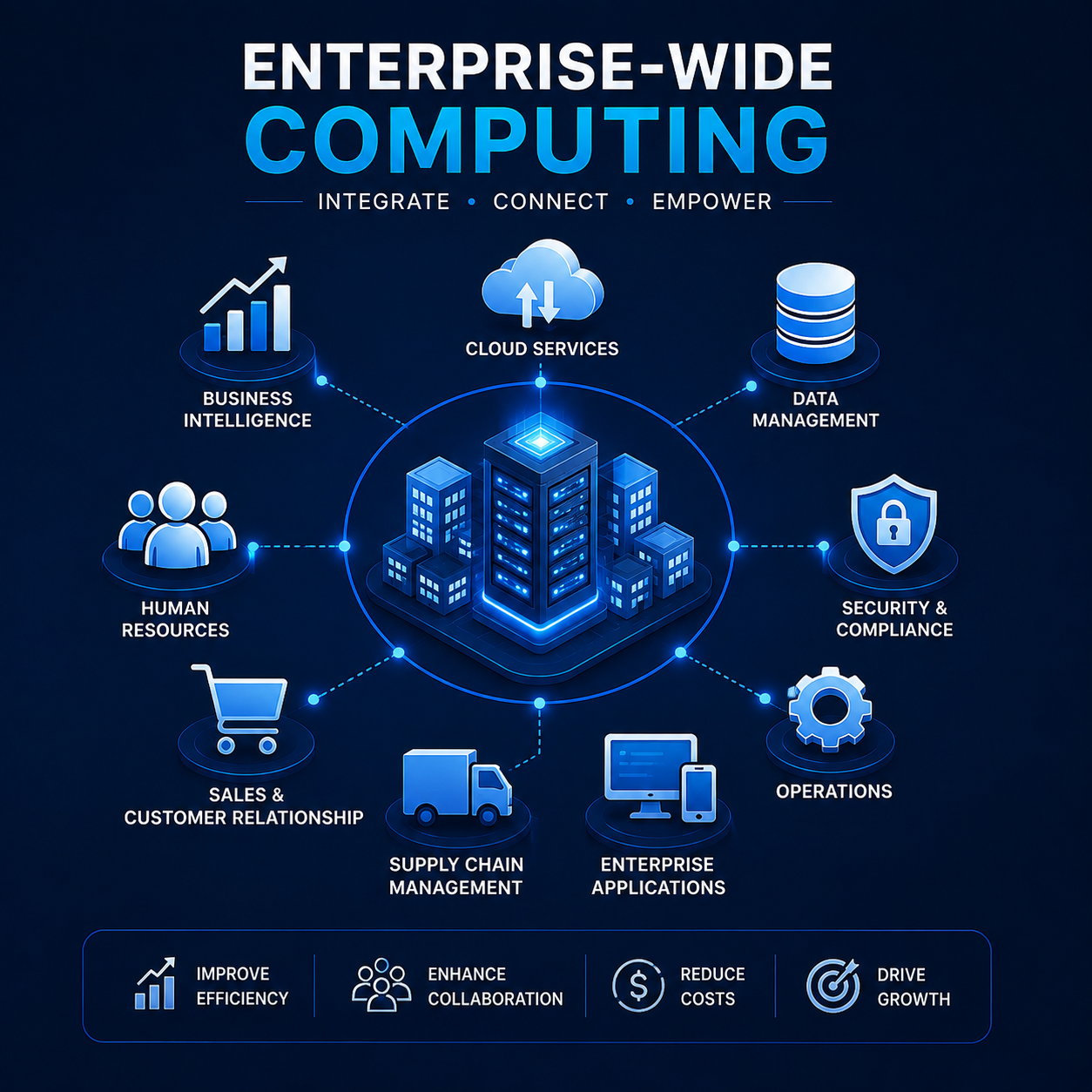
Enterprise-Wide Computing is a comprehensive course unit designed to provide learners with an understanding of how information technology systems, applications, data, infrastructure, and business processes are integrated and managed across an entire organization.
The course examines the transition from isolated departmental computer systems to integrated enterprise computing environments that enable different departments, branches, employees, customers, suppliers, and other stakeholders to share information and services efficiently.
Learners are introduced to enterprise computing architectures and major enterprise information systems, including Enterprise Resource Planning (ERP), Customer Relationship Management (CRM), Supply Chain Management (SCM), Human Resource Management Systems (HRMS), financial management systems, and Business Intelligence (BI) platforms. Emphasis is placed on understanding how these systems support organizational operations, management, communication, collaboration, and strategic decision-making.
The course further explores enterprise networking, databases, distributed systems, client/server computing, web-based systems, cloud computing, virtualization, middleware, APIs, web services, and system integration technologies that enable different enterprise applications to communicate and exchange information.
Learners also examine enterprise data management, business process integration and automation, information security, identity and access management, backup and disaster recovery, scalability, availability, performance, governance, and enterprise IT infrastructure management.
Modern approaches to enterprise computing are introduced, including cloud-based enterprise systems, Software as a Service (SaaS), mobile enterprise applications, microservices, artificial intelligence, data analytics, Internet of Things (IoT), and digital transformation.
Through practical activities, case studies, and enterprise system design exercises, learners will analyze organizational requirements and develop appropriate technology solutions that integrate people, processes, data, applications, and infrastructure.
By the end of the course, learners should be able to understand, analyze, design, and evaluate enterprise-wide computing environments and explain how integrated information systems can improve operational efficiency, collaboration, decision-making, service delivery, innovation, and organizational competitiveness.
Fees Structure
| Item | Amount (UGX) |
|---|---|
| Course Fees | Free |
| Registration | Free |
| Total | Free |
Enrollment closes Aug 22, 2026.
Course Outline (Weekly)
| Week | Topics |
|---|---|
| Week 1 | Introduction to Enterprise-Wide Computing |
| Week 2 | Enterprise Computing Architecture |
| Week 3 | Enterprise Information Systems |
| Week 4 | Enterprise Resource Planning (ERP) Systems |
| Week 5 | Customer Relationship Management (CRM) |
| Week 6 | Supply Chain Management (SCM) Systems |
| Week 7 | Enterprise Data Management |
| Week 8 | Enterprise Networking and Infrastructure |
| Week 9 | Distributed and Client/Server Computing in Enterprises |
| Week 10 | Enterprise Application Integration (EAI) |
| Week 11 | Cloud Computing and Virtualization |
| Week 12 | Business Process Management and Automation |
| Week 13 | Enterprise Security and Access Management |
| Week 14 | Business Intelligence and Enterprise Analytics |
| Week 15 | Enterprise Systems Management and Governance |
| Week 16 | Emerging Trends in Enterprise Computing |